Human & Machine Creative Cognition
Creative cognition
Innovation in science, the arts, and society relies on core cognitive capacities: forming mental representations, imagining novel images and concepts, and reasoning by analogy. I study how people generate and enhance novel content—and, in the era of generative AI, how machine systems compare, complement, and sometimes challenge human creative cognition.
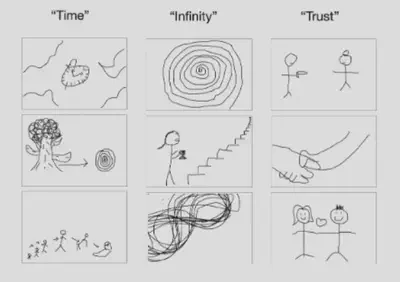
Human vs. machine creative (generative) cognition
What I ask
- How do humans and machines represent abstract, symbolic concepts (e.g., time)?
- How do humans and machines generate novel visual outputs by overriding familiar patterns?
- When and how can machines augment human creativity in writing, sketching, and idea generation?
What I’ve found
- Human drawings completed from incomplete visual lines were more diverse and more distinctive than those produced by current image-generation models.
- These differences may stem from models’ preference for global over local attention.
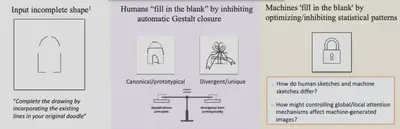
- As of 2025, Large language models (LLMs) appear to generate verbal inspiration more effectively than visual inspiration when facilitating human creative sketching.
How I study it
- Naturalistic, large-scale big data approach
- Controlled sketching paradigms
- Human-AI hyrbid web platform
Some of the hybrid platforms are available for you to try it out under the Resources tab
Developmentally aligned large language models
Recent advances in large language models (LLMs) have achieved remarkable success on a variety of linguistic and reasoning tasks. However, current pre-training approaches rely predominantly on massive, static corpora of adult-level text, overlooking the incremental, developmental processes by which human knowledge emerges and evolves. Drawing inspiration from developmental robotics, cognitive modeling, and curriculum learning, we propose a position to integrate developmental milestones into LLM training. By systemati- cally structuring training inputs according to these bench- marks, LLMs could become powerful computational plat- forms for testing developmental hypotheses in cognitive sci- ence. We discuss the practical challenges of assembling suit- able datasets, highlight existing resources, and examine how such models could foster deeper collaboration between AI re- searchers and developmental scientists.
This project is under development. Please find the poster link

Recent focus
Creative initiators vs. solvers
I have developed a full “Tangram” web game to study visual and spatial imagery, visual and spatial creative generation.